
Il volontariato oncologico: forza trainante dell’oncologia italiana
7 ottobre, h 14:00 in U6 Aula Martini, Piano -1

È in corso una rivoluzione epocale per le Associazioni di volontariato dei pazienti oncologici: non più solo portavoce di bisogni e diritti, ma vere e proprie protagoniste della sanità pubblica. La loro azione abbraccia ogni tappa del percorso di cura: prevenzione, screening, accesso ai farmaci innovativi, riabilitazione, reinserimento sociale e lavorativo e tutela della qualità della vita. Questa transizione verso una partecipazione attiva si realizza nei luoghi chiave del SSN: dalle Reti Oncologiche Regionali ai tavoli del Ministero della Salute, fino ai processi di valutazione dell’innovazione terapeutica di AIFA. Affermandosi nei processi di co-programmazione e ricerca, le Associazioni sono oggi partner strategici indispensabili per la governance dell’oncologia in Italia.

Francesco De Lorenzo – Medico, è stato Professore ordinario di Chimica Biologica presso l’Università di Napoli Federico II. È stato Ministro della Sanità della Repubblica Italiana dal 1989 al 1993 e oggi è particolarmente impegnato nella promozione dei diritti dei pazienti oncologici, come presidente della Federazione Italiana delle Associazioni di Volontariato in Oncologia (FAVO)
Condividi su


Via Bicocca degli Arcimboldi 8, 30126, Milano
Università degli Studi di Milano-Bicocca
Edificio U7 – Civitas
Unblocking writing: Effective and Efficient
Knowledge Transfer « Publish and Flourish»
10 giugno, h 10:30 in U7-4057
con Linda Pagani– Professor at the School of Psycho-Education of the Faculty of Arts and Sciences at the Université de Montréal
FOR PHD & YOUNG RESEARCHERS
Part 1. Stable mind – Healthy existence – Realizing one’s potential.
Part 2. Efficiently academic story-telling
in the form of a paper that can be written in 5 days.
Part 3. Effective knowledge transfer, from the first submission/rejections and resubmission, to then getting it on the news and dealing with journalists.
Part 4. Advice on easy paper production in
academic yet reader-friendly English, for people whose first language is not English.

Condividi su
Via Bicocca degli Arcimboldi 8, 30126, Milano
Università degli Studi di Milano-Bicocca
Edificio U7 – Civitas
Childhood, Family and the Future:
Evidence‑Based Insights for a Healthy 21-st
Century Lifestyle During the Early Years
10 giugno, h 09:30 in U7-4057
con Linda Pagani – Professor at the School of Psycho-Education of the Faculty of Arts and Sciences at the Université de Montréal
Join Linda S. Pagani as she traces more than three decades of scientific inquiry into human development and family environments. Drawing on a rich body of prospective‑longitudinal research, Professor Pagani will offer a powerful and integrative perspective on what truly shapes children’s trajectories, and how these insights illuminate the foundations of a healthy and meaningful lifestyle in the 21st century. Her visit and conference will weave together empirical evidence, developmental theory, and reflections on contemporary challenges to propose a clear, research‑grounded vision of “what matters most” for human flourishing in our modern world. This is a rare opportunity to hear a leading scholar and clinician synthesize a lifetime of work into a forward‑looking conceptual framework that speaks directly to those concerned with population health and deeply invested in the well‑being of future generations.
Condividi su
Via Bicocca degli Arcimboldi 8, 30126, Milano
Università degli Studi di Milano-Bicocca
Edificio U7 – Civitas
The Spatial Equilibrium Effects of Hospital Closures
8 maggio, h 12:00 in U6-01b
con Vincenzo Carrieri, Professore Ordinario di Scienza delle Finanze & Direttore del Centro Studi su Società, Salute e Territorio, Università della Calabria
Over the past two decades, cost containment has become a central objective of public policy in advanced economies, often targeting locally provided public services such as hospitals. This paper studies how hospital department closures triggered by post-crisis reforms in Italy reshape healthcare provision and generate broader place-based effects. Using highly granular ward-level data for the universe of Italian public hospitals (2015–2022), we exploit staggered variation in closures and implement a difference-in-differences design. We show that closures act as localized supply shocks, increasing activity volumes and congestion in neighboring same-specialty departments, with selective deteriorations in quality. Extending the analysis to municipalities, we document reductions in natality, increases in mortality, and declines in per-capita income and income distribution indicators in areas exposed to closures. The findings highlight non-trivial efficiency–equity trade-offs and underscore the importance of accounting for spatial equilibrium and place-based effects when evaluating hospital downsizing policies.
Condividi su
Via Bicocca degli Arcimboldi 8, 30126, Milano
Università degli Studi di Milano-Bicocca
Edificio U7 – Civitas
Shaping Soft Drinks:
Sugar Taxes, Consumption, and Reformulation in Europe
25 maggio, h 14:30 in U6-18
con Cinzia di Novi, Professor in Public Economics at University of Pavia and President of the Italian Health Economics Association (AIES)
Sugar-sweetened beverages are a major source of free sugars in Western diets. In response, several European countries have introduced taxes to encourage product reformulation and reduce consumption. This study assesses how these taxes affected sales in off-trade and on-trade markets, examines consumers’ potential substitution effects using Euromonitor data (2004–2019), and evaluates manufacturers’ reformulation responses through Mintel product-launch data (2010–2019). We focus on six countries that implemented such taxes, specifically Belgium, France, Hungary, Ireland, Portugal, and the United Kingdom, and additionally analyse Denmark, which introduced a similar tax earlier and repealed it in 2014, providing a reverse test case. Using a synthetic control approach, we construct counterfactual scenarios to estimate tax impacts. We find significant sales effects only under progressive tax designs, while reformulation emerged consistently, particularly where sugar thresholds and implementation timelines were clearly defined.

Condividi su
Via Bicocca degli Arcimboldi 8, 30126, Milano
Università degli Studi di Milano-Bicocca
Edificio U7 – Civitas
April 15 2026, h 14:30
Seminar Room U7-4057
with Andrea Rotnitzky – Professor at the Department of Biostatistics, University of Washington and Recipient of 2022 Rousseeuw Prize for Statistics
The paper focuses on proximal causal inference, a framework that allows researchers to estimate causal effects even when some important confounders are unmeasured, by using observed proxy variables. Traditionally, this approach has been applied to settings with fixed treatments or interventions based on baseline characteristics.
This work extends the framework to more complex situations with continuous treatments, specifically considering scenarios where each individual’s observed treatment is systematically modified (known as modified treatment regimes).
The main contributions are:
– proposing a flexible method that does not require all confounders to be measured;
– using modern debiased machine learning techniques to avoid strong parametric assumptions.
The methodology is motivated by studies on COVID-19 vaccines, where key factors like an individual’s immune capacity are not directly observed. The approach is validated using real data and simulation studies.

Condividi su
Via Bicocca degli Arcimboldi 8, 30126, Milano
Università degli Studi di Milano-Bicocca
Edificio U7 – Civitas
with Prof. Saverio Strages from Western University in Canada
The seminar will provide an overview on the relevance of sleep health as a major but still neglected public health priority globally. Dr. Stranges will present some of his epidemiological work from population-based studies on the link between sleep problems and chronic disease risk, with emphasis on social determinants of health and disparities in the distribution of the disease burden associated with poor sleep patterns.

Condividi su
Via Bicocca degli Arcimboldi 8, 30126, Milano
Università degli Studi di Milano-Bicocca
Edificio U7 – Civitas
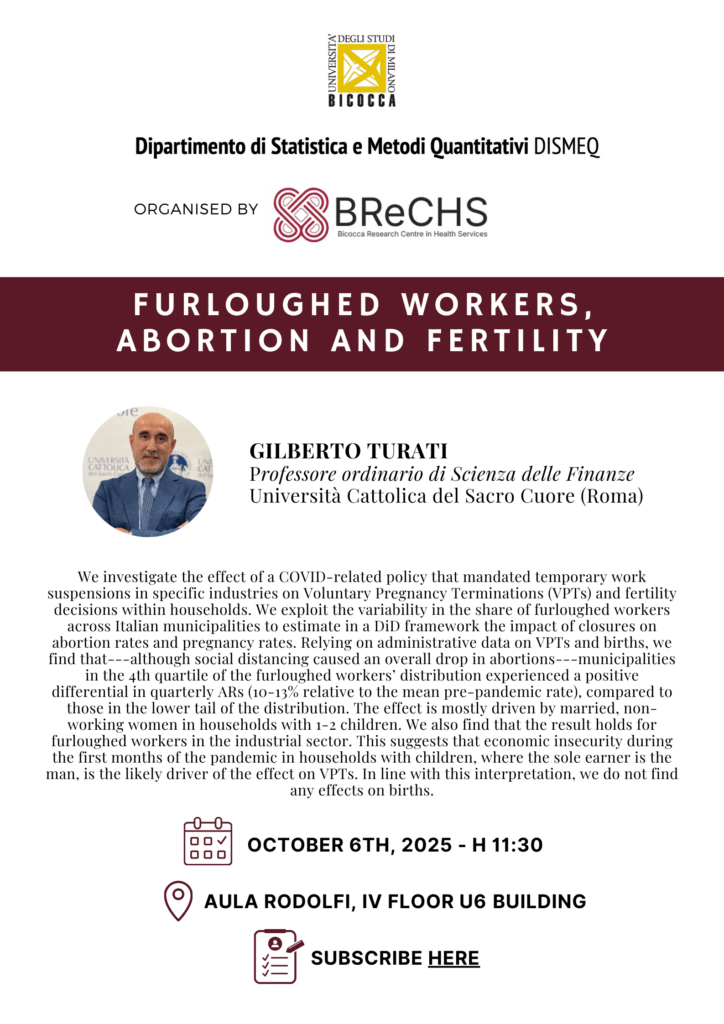
Furloughed workers, abortion and fertility
We investigate the effect of a COVID-related policy that mandated temporary work suspensions in specific industries on Voluntary Pregnancy Terminations (VPTs) and fertility decisions within households. We exploit the variability in the share of furloughed workers across Italian municipalities to estimate in a DiD framework the impact of closures on abortion rates and pregnancy rates. Relying on administrative data on VPTs and births, we find that—although social distancing caused an overall drop in abortions—municipalities in the 4th quartile of the furloughed workers’ distribution experienced a positive differential in quarterly ARs (10-13% relative to the mean pre-pandemic rate), compared to those in the lower tail of the distribution. The effect is mostly driven by married, non-working women in households with 1-2 children. We also find that the result holds for furloughed workers in the industrial sector. This suggests that economic insecurity during the first months of the pandemic in households with children, where the sole earner is the man, is the likely driver of the effect on VPTs. In line with this interpretation, we do not find any effects on births.
Condividi su
Via Bicocca degli Arcimboldi 8, 30126, Milano
Università degli Studi di Milano-Bicocca
Edificio U7 – Civitas
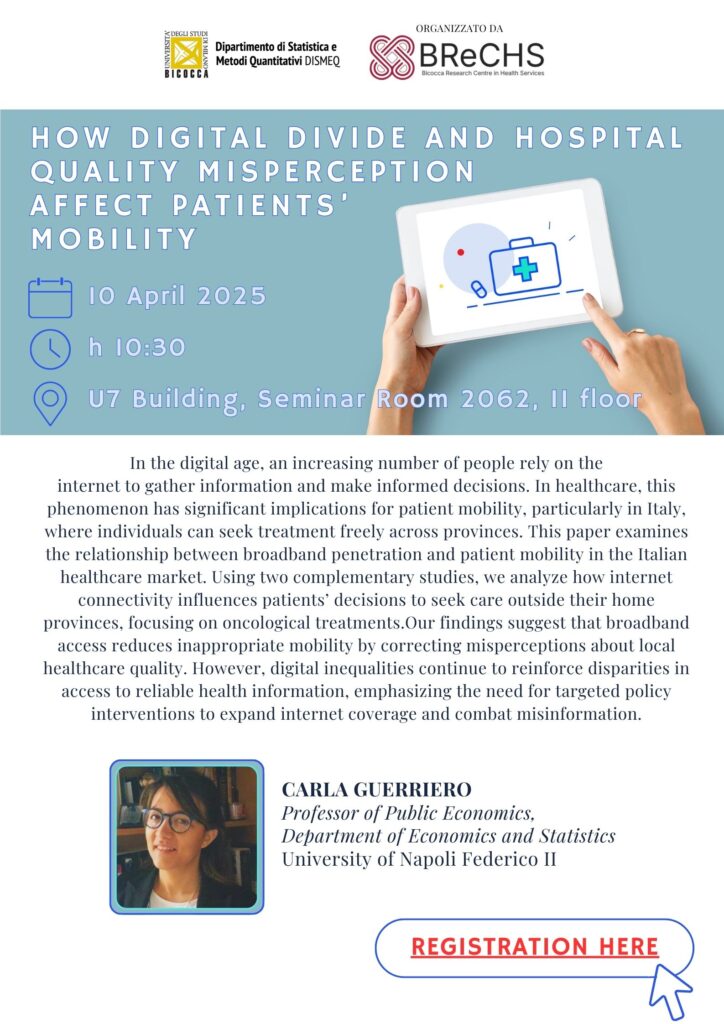
How digital divide and hospital quality misperception affect patients’ mobility
In the digital age, an increasing number of people rely on the internet to gather information and make informed decisions.
In healthcare, this phenomenon has significant implications for patient mobility, particularly in Italy, where individuals can seek treatment freely across provinces.
This paper examines the relationship between broadband penetration and patient mobility in the Italian healthcare market. Using two complementary studies, we analyze how internet connectivity influences patients’ decisions to seek care outside their home provinces, focusing on oncological treatments.
Our findings suggest that broadband access reduces inappropriate mobility by correcting misperceptions about local healthcare quality.
However, digital inequalities continue to reinforce disparities in access to reliable health information, emphasizing the need for targeted policy interventions to expand internet coverage and combat misinformation.
Condividi su
Via Bicocca degli Arcimboldi 8, 30126, Milano
Università degli Studi di Milano-Bicocca
Edificio U7 – Civitas
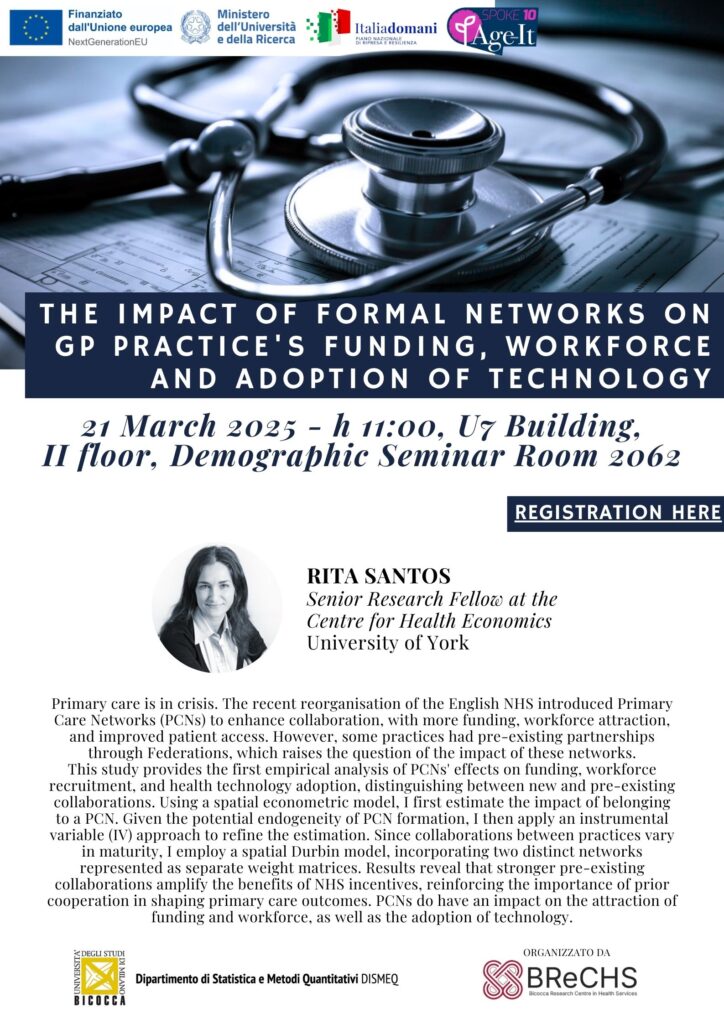
The impact of formal networks on GP practice’s funding, workforce and adoption of technology
Dott.ssa Irene Torrini
Postdoctoral Researcher in Economics at Bocconi University
Recently published statistics show that 50% of patients over 70 are discharged from the hospital 7 days later, due to lack of social support after hospitalization. Despite this alarming evidence, social care remains largely underfunded and the interdependency between the social and hospital systems unquantified.
In this study, we merge admission- and municipality-level national data and use a two-stage econometric approach to estimate the effect of municipal social spending on hospital-related outcomes for elderly patients. The hypothesis we test is that hospital care is a substitute for poor social services.
The main findings show that a higher level of social spending reduces the number of hospitalizations, as well as the length of stay and cost per admission. These results call for urgent policy interventions to increase post-discharge social support for the elderly and increase coordination among different areas of care.
Condividi su
Via Bicocca degli Arcimboldi 8, 30126, Milano
Università degli Studi di Milano-Bicocca
Edificio U7 – Civitas